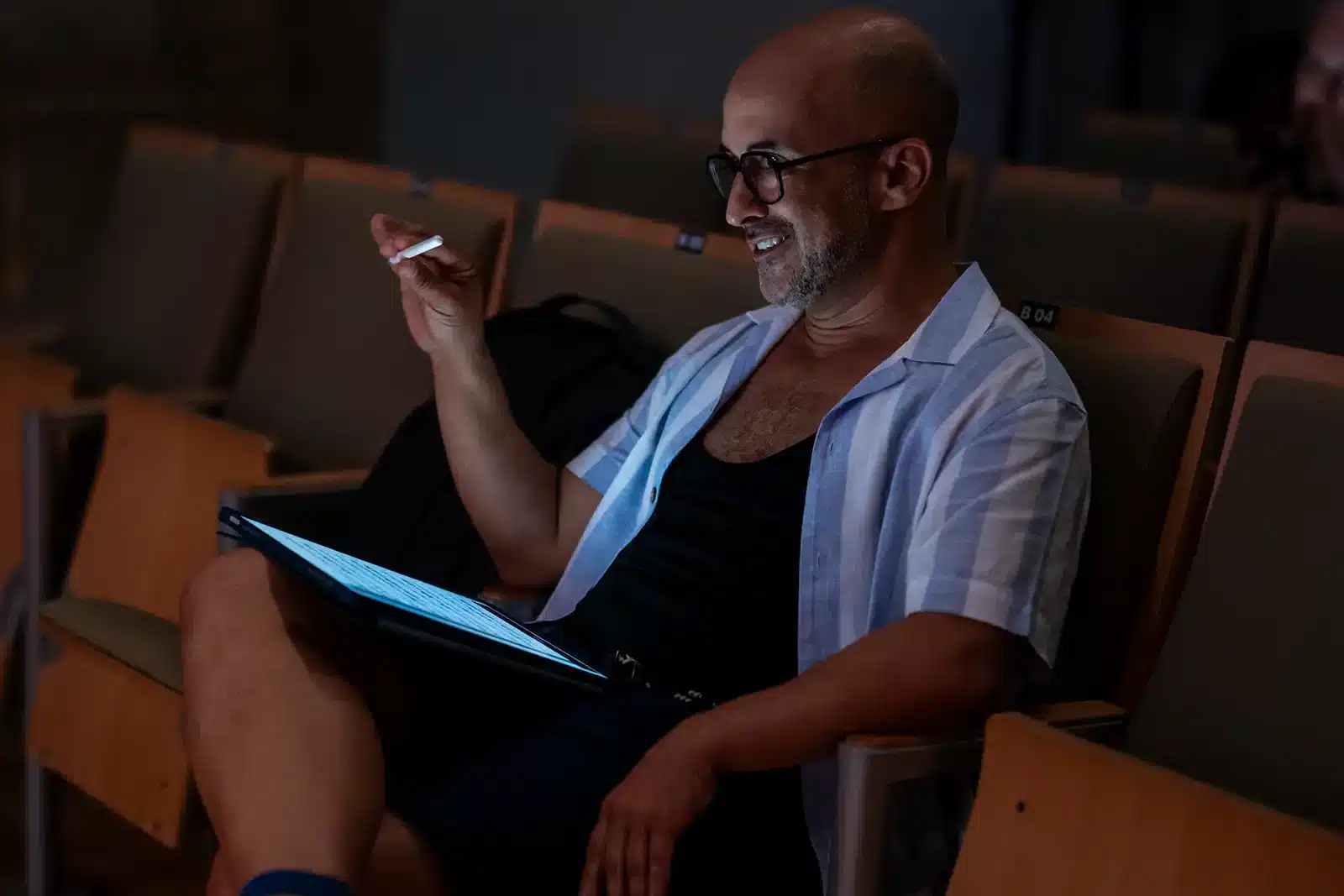
Jorge Balça, director and acting tutor at Cascais Opera 2026
Jorge Balça makes a distinction that seems simple but isn’t. An opera singer, he says, is someone who sings opera music. An opera performer does that too, but with their body, with the character, with the theatre. And it is exclusively with the latter that he works. “As a director, a voice on its own is of absolutely no use to me. It’s of no use to me at all”.
The statement is provocative, but the logic is flawless. “If the voice is very beautiful, I can listen to recordings at home on my high-fidelity stereo… sometimes with better sound quality than in a theatre. But it’s just a voice”. What Jorge Balça is looking for – and what he tries to convey in his masterclasses at Cascais Opera – is something else: the living character, the story being told, the body on stage.
The voice that arises from the body
The central concept of Balça’s work is that of the ‘embodied voice’. “Unfortunately, we sometimes see singers singing with voices that are not in their bodies – what are known as ‘disembodied voices’”. The aim of his masterclasses, held during Cascais Opera, was precisely the opposite: to return the voice to the body, to treat it as a physical phenomenon rather than merely a sound, and to use the body as an expressive vehicle for the drama.
“We can catch a glimpse of the character in the way the body reacts to the voice”. It is this reaction, this interplay between what is heard and what is seen, which, according to him, is the essence of operatic performance. “Sometimes it is in the vocal imperfections that the character can be found. I don’t believe a character can come to life without both elements”.
Three techniques for a well-rounded artist
For Jorge Balça, the training of an opera singer is based on a triad: vocal technique, physical technique and dramatic technique. And all three must be worked on simultaneously, ideally right from the start. “You need to take plenty of drama lessons and follow a physical training regime. Whether it’s yoga, Pilates, the gym… something that builds not only strength but also flexibility, so that you have a palette as rich in your body as you do in your voice”.
One of the most unexpected pieces of advice he gives his students is to take clowning classes. “It’s extremely uncomfortable. It explores the ridiculous – our own personal ridiculousness – and then transforms it into performance. Having that ability and willingness to embrace the ridiculous is very important”. The logic is the same as ever: discomfort is where learning takes place.
And in response to the argument that physical work can be detrimental to the voice, Balça is categorical: “We are not pulling in opposite directions. When the body and the voice are well integrated, underpinned by a solid dramatic foundation, all that work will help the voice and make it more confident”.
Telling the story is everything
Ultimately, says Jorge Balça, opera is simple. “The work is very simple; it’s about telling a story. It just so happens that the words are set to music”. It is this simplicity that forms the basis of his entire approach: no vocal technique or stage presence is of any value unless it serves a story that resonates with the audience.
Jorge Balça offered two distinct pieces of advice to the Cascais Opera candidates, depending on where they were in their careers. For those just starting out: “Throw yourselves into it headfirst. Don’t be afraid of making mistakes. If we’re going to fail, let’s fail spectacularly – and let that be exciting”. For the candidates in the competition: “Be confident that your voice will be on point, that the technical work has been done. Stop worrying about technique… and enjoy yourselves. Tell the story. Look at the audience and connect with them”.
“Tell the story”. That is the phrase with which it ends. And it is also, ultimately, the reason why opera exists.