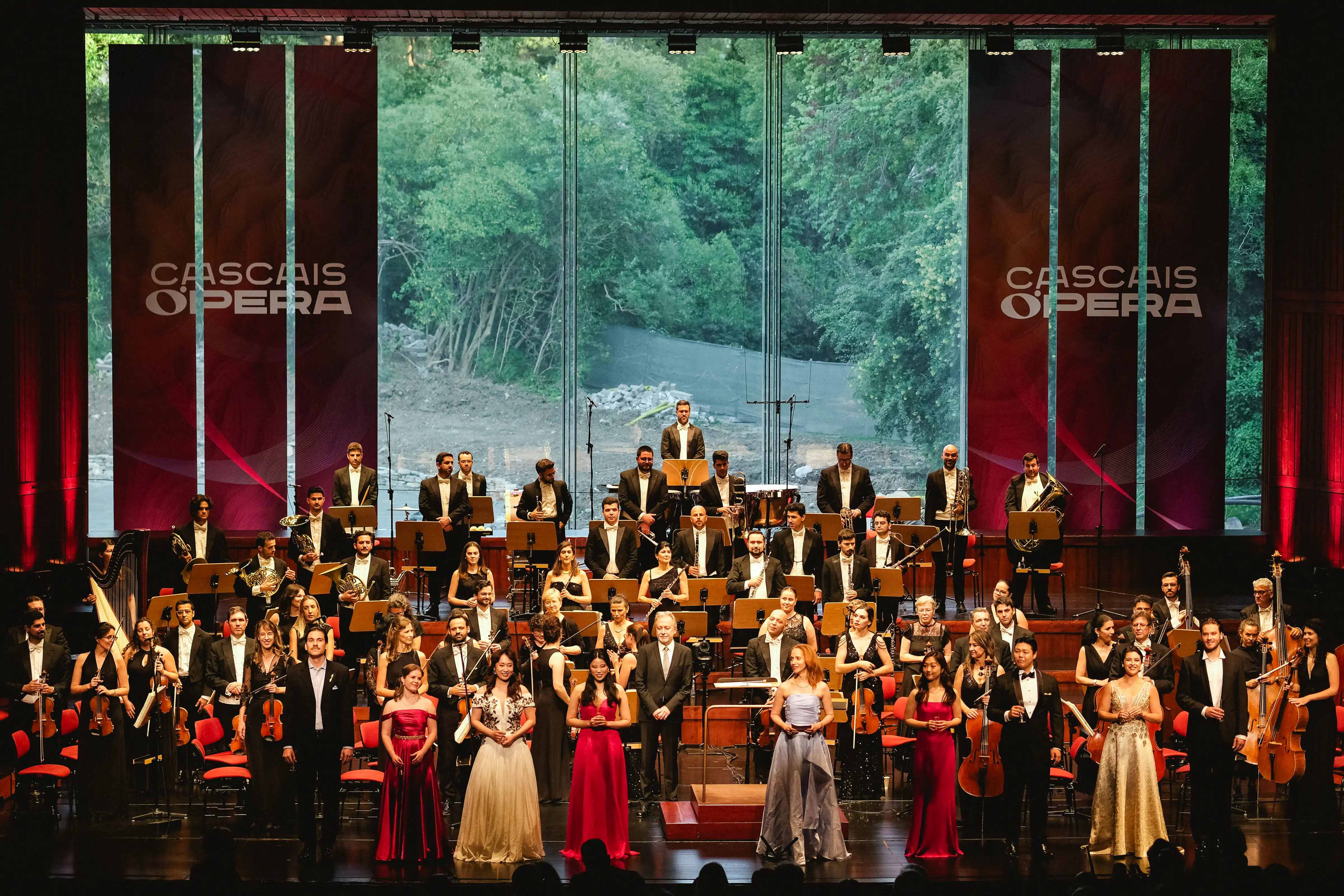
The Grand Auditorium of the Calouste Gulbenkian Foundation was packed on Sunday evening for the Grand Final of Cascais Opera 2026. Ten days after the start of a competition that began with 499 entries from 59 countries, eight voices took to the stage that could change a career, accompanied by the Cascais Symphony Orchestra, conducted by António Pirolli, and presented by musicologist Inês Thomas Almeida.
The orchestra opened the proceedings with the overture to Rossini’s La Gazza Ladra, composed when the composer was just 23 years old. It was an energetic, assertive start that set the stage for what was to come.
The first half: betrayals, love and freedom
Arianna Manganello, an Italian mezzo-soprano from the Deutsche Oper Berlin, opened the finalists’ performances. First with “Ah chi mi dice mai” from Mozart’s Don Giovanni – the aria in which Donna Elvira, having just discovered she has been betrayed, seeks out the seducer to confront him. Then, with the famous letter aria from Massenet’s Werther, in which Charlotte, on Christmas Eve, rereads Werther’s love letters, torn between melancholy and sweet memories, ending with the threat of an impossible love. As Inês Thomas Almeida described it, it is one of the most emotionally charged scenes in the entire mezzo-soprano repertoire.
Next up was Beatriz Maia, the only Portuguese contestant in the competition. Her first aria was “Gualtier Maldé… Caro nome” from Verdi’s Rigoletto – the young Gilda dreamily and beautifully idealising the figure of the mysterious man with whom she meets in secret, unaware that he is the arrogant Duke of Mantua. The second was “Salut à la France” from Donizetti’s La Fille du Régiment – the young Marie discovering her origins and, at the same moment, finally able to marry the man she loves, in an aria of patriotic fervour that earned Donizetti the title of best Italian composer in Paris.
Seonwoo Lee transported the audience into the world of courtesans. First with “Je marche sur tous les chemins” from Massenet’s Manon – Manon who, at the height of her social life, celebrates her own beauty and reminds us that youth will not last forever, so the time to love is now. Then with “È strano!… Sempre libera” from Verdi’s La Traviata, in which Violetta Valéry extols the freedom to be and love whomever she wishes, even if that path proves tragic.
Junyoung Choi brought the first half to a close with two Verdi works that are also worlds apart. The “Hai già vinta la causa” from Mozart’s The Marriage of Figaro – Count Almaviva realising he is being duped, in an opera in which, as Inês Thomas Almeida pointed out, Mozart and Da Ponte achieve something extraordinary: they offer a glimpse of the times. At the end of the 18th century, it is the servants and common folk who get the better of the aristocrats, given that the opera premiered in Vienna just three years before the French Revolution. Then, “È sogno? o realtà?” from Verdi’s Falstaff, a comedy that demands a rare vocal and dramatic maturity.
The Intermezzo from Leoncavallo’s Pagliacci divided the two halves of the evening – one of the most famous moments in all Italian verismo, oscillating between the mysterious and the expectant and the intense melodic lines of a passionate drama.
The second half: Beethoven, Puccini, Mozart, Tchaikovsky and Wagner
Wu Tongyu opened the second half with Beethoven’s Fidelio – the German master’s only opera, in which the ideals of liberty, equality and fraternity resonate. The aria “O wär ich schon mit dir vereint” is sung by the young Marzelline who, unaware that Fidelio is Leonora disguised as a man, falls in love and sings, full of illusions about the happiness of them both being united by love. Next came “Sì, mi chiamano Mimì” from Puccini’s La Bohème – the young Mimì, who has just met the poet Rodolfo, recounts her humble story, yet one of such intense poetry and musicality that Puccini constructs it “like an intoxicating elixir”, in the words of Inês Thomas Almeida.
Nuri Park presented two moments of great virtuosity. The “Chacun le sait” from Donizetti’s La Fille du Régiment – Marie extolling the virtues of the 21st Infantry Battalion – and then the “Ei parte… Per pietà’ from Mozart’s Così fan tutte, in which Fiordiligi, torn between her love for her fiancé and her budding feelings for another man, decides to remain faithful in an aria of intense dramatic charge, with great leaps between the high and low registers, which would later serve as a model for Beethoven in creating Leonora’s arias in Fidelio.
Tomislav Jukić transported the audience to Russia and from there to Paris. The “Kuda, kuda” from Tchaikovsky’s Eugene Onegin – the young poet Lenski reflecting bitterly on life and wondering where the happy hours have gone – followed by “Che gelida manina” from Puccini’s La Bohème, the aria in which Rodolfo takes Mimì’s cold hand and tells her who he is, crafted with a melodic imagination of extraordinary richness.
Ljubomir Milanović brought the solo performances to a close with two contrasting worlds. First Wagner – the “O du mein holder Abendstern” from Tannhäuser, in which Wolfram, having just sensed the death of Elisabeth, whom he loved in secret, asks the evening star to gather her up and protect her: one of the most sublime passages in the entire baritone repertoire. Then, a return to Mozart and Don Giovanni – the “Finch’han dal vino”, in which the seducer instructs Leporello to prepare a grand party with wine, dancing and invitations to all the girls he can find, as he plans to add at least ten more beauties to his already long list.
The finale, the prizes and the winners
Once the individual performances were over, the eight finalists returned to the stage together for the finale – the Champagne Chorus from Strauss II’s Die Fledermaus, the same number that had closed both the Opening Concert and the Semi-Finalists’ Concert in this edition. It was a scene of celebration and camaraderie that brought this final full circle.
The jury withdrew to deliberate. The audience – both in the hall and around the world – voted for their favourite. And at 9.15 pm, the awards ceremony, with over 55,000 euros in prizes and contracts to be distributed, began.
Over ten days, Cascais Ópera 2026 brought 39 candidates to Cascais, who took part in in-person auditions, masterclasses with some of the most renowned experts in European opera, a semi-finalists concert at the Palácio da Cidadela in Cascais, and a final at the Gulbenkian. It ends as it began: with the conviction that there are new voices in the world, and that some of them have passed through here.