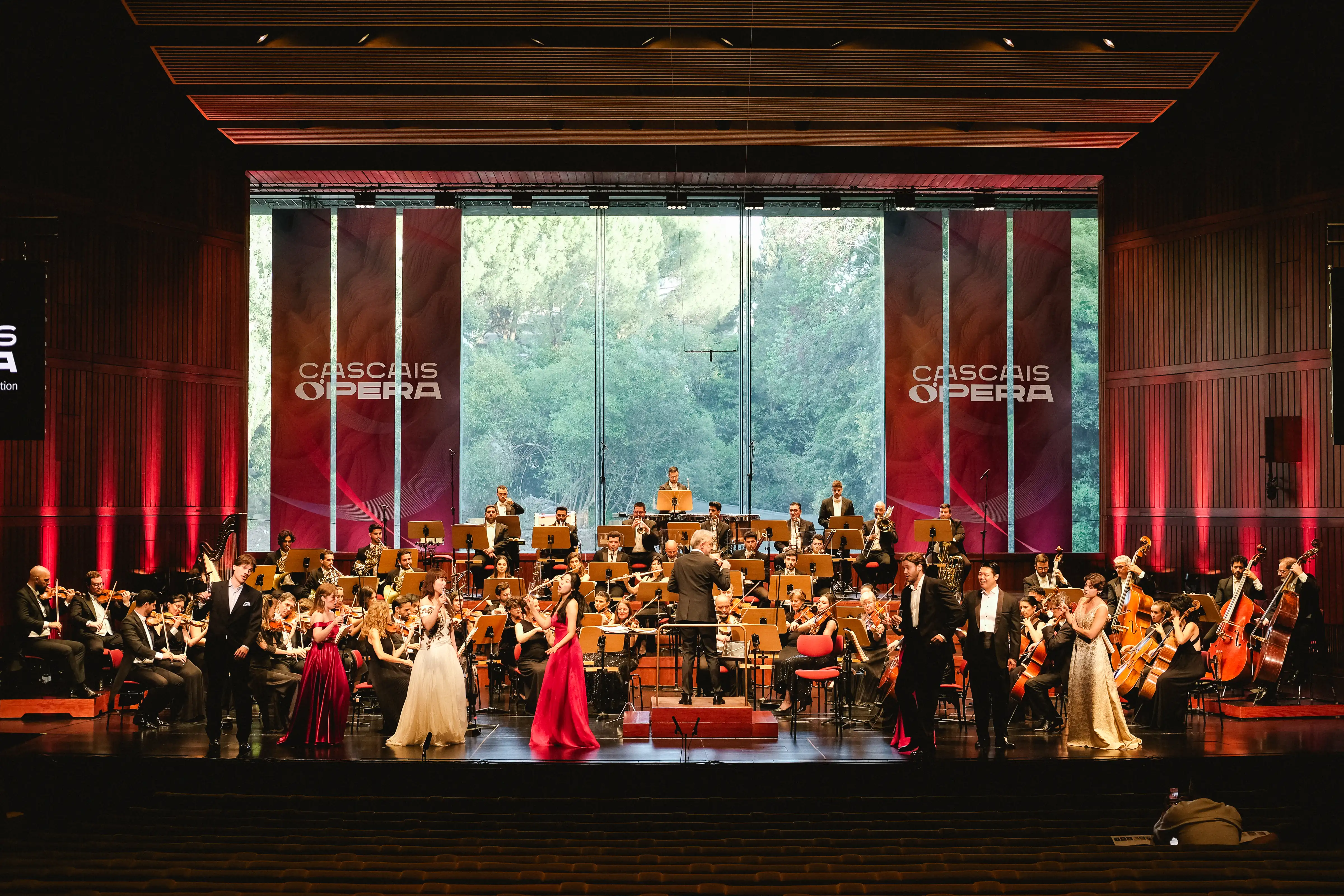
One week. Thirty-nine singers from twenty-five countries. Hundreds of hours of music, rehearsals, masterclasses, nerves and shared joy. It all came together on this evening. At 6 pm, the Grand Auditorium of the Calouste Gulbenkian Foundation opens its doors for the Cascais Opera 2026 Final… and eight voices take to the stage that could change a career.
The programme is set. The Cascais Symphony Orchestra, conducted by Maestro Antonio Pirolli, accompanies each of the finalists in two arias from their repertoire. Rossini opens the evening with the overture to La Gazza Ladra – a prelude that is, in itself, a declaration of energy and intent. The Intermezzo from Leoncavallo’s Pagliacci divides the concert in two, separating the before from the after.
Eight finalists, sixteen arias
Arianna Manganello, the Italian mezzo-soprano from the Deutsche Oper Berlin, opens with Mozart – the “Ah chi mi dice mai” from Don Giovanni – and closes with Massenet, in a scene from Werther that is one of the most dramatic moments in the mezzo-soprano repertoire.
Beatriz Maia, the only Portuguese contestant, performs two of the roles that suit her best: Gilda from Verdi’s Rigoletto, with the celebrated aria “Caro nome”, and Marie from Donizetti’s La Fille du Régiment, a role she has already performed on stage, and which demands both coloratura and stage presence.
Seonwoo Lee, a South Korean soprano who trained at the Opernstudio of the Bayerische Staatsoper, presents Massenet’s Manon and Violetta from Verdi’s La Traviata – “È strano!… Sempre libera”, the aria of liberation and ambiguity, one of the most demanding in the soprano repertoire.
Junyoung Choi, a South Korean baritone, has chosen two Verdi roles: the Count in The Marriage of Figaro and Falstaff – a role he has his sights set on and which demands a vocal and dramatic maturity rarely found in a 29-year-old singer.
Wu Tongyu, the youngest finalist at just 23, performs Beethoven’s “O wär ich schon mit dir vereint” from *Fidelio* and Puccini’s “Sì, mi chiamano Mimì” from *La Bohème*, one of the most beloved moments in the soprano repertoire.
Nuri Park, a South Korean soprano trained in Vienna, presents Marie from Donizetti’s opera and “Per pietà” from Mozart’s Così fan tutte – an aria of rare beauty and technical difficulty that demands both breath control and the expression of despair.
Tomislav Jukić, a Croatian tenor from the Zurich International Opera Studio, performs Lenski from Tchaikovsky’s Onegin and Rodolfo from La Bohème – two of the most famous arias in the tenor repertoire, in completely different languages and worlds.
And Ljubomir Milanović, the 26-year-old Serbian baritone studying in Mannheim, brings the cycle to a close with Wagner – the “Abendstern” from Tannhäuser, one of the most sublime passages in the Wagnerian baritone repertoire – and with the Champagne from Don Giovanni, the very villain who runs through this entire evening.
A conversation about the future of opera
Between the concert and the awards ceremony, there is a moment that goes beyond the competition. Moderated by Hugo van der Ding, the discussion “One day we shall all go to the Opera”, under the theme – Without Patrons there is no Traviata – brings together patrons and partners of Cascais Opera to talk about something that is rarely discussed openly: without support, there is no opera. Without patrons, there is no Traviata. Ambassador António Monteiro, from the Millennium bcp Foundation, José Pena do Amaral, from the BPI La Caixa Foundation, and Jorge Leitão, from Leitão & Irmão Joalheiros, will share the table in a conversation about what it means to support culture, and why it matters.
The ceremony and what remains
At 9.15 pm, the awards ceremony. The jury – chaired by Sergei Leiferkus and comprising some of the most renowned figures in the international opera world – will have reached its decision during the one-hour interval. The awards will be presented. The names will be announced. And the third edition of Cascais Opera will reach its formal conclusion.
But there is something that does not end tonight. The careers that began here, or that took an important step forward here, continue. The relationships forged this week between singers, mentors and industry professionals continue. And Cascais Opera, which in three editions has gone from an idea to an international benchmark, continues.
Tonight, at the Gulbenkian, we will hear eight voices. In ten years, some of them will be on the world’s greatest stages. And someone will remember hearing them for the first time in Cascais.