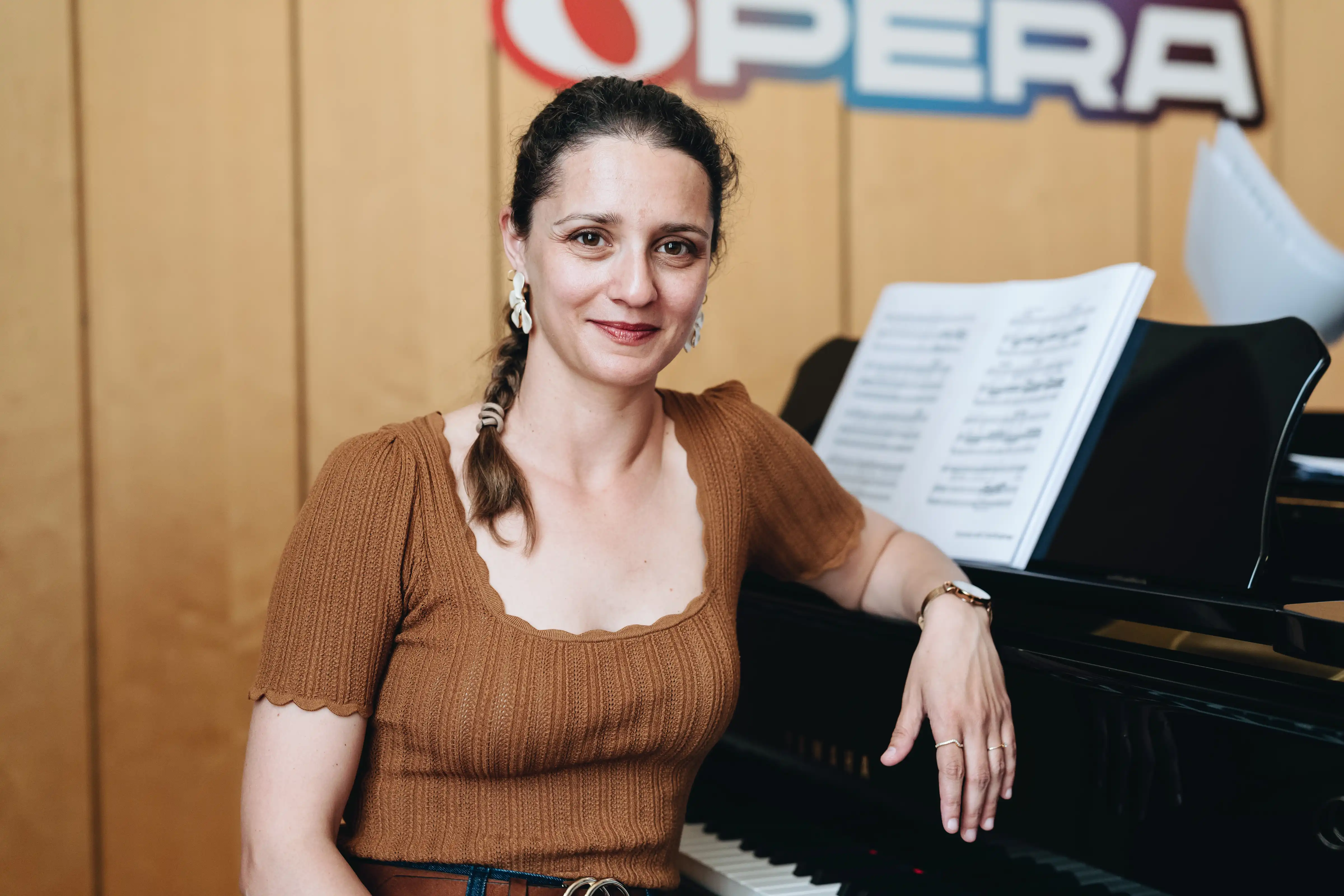
Ana Filipa Luz, accompanist at Cascais Opera 2026
Ana Filipa Luz’s name appears in the programme for the Cascais Opera 2026 Semi-Finalists’ Concert as a collaborative pianist, alongside Ekaterina Byron and Michael Saks. It is a small, discreet credit, as is always the case for those who accompany. But anyone familiar with the world of opera knows what lies behind that name: hours of preparation, extreme concentration, and the responsibility of being the invisible foundation upon which each singer builds their performance.
“There is a symbiosis,” says Ana Filipa Luz. “For everything to go very well, for the singer to give their best performance, the work with the pianist has to be solid”. It is a relationship that begins long before the stage: it begins in the preparatory rehearsals, in the choice of repertoire, in the building of mutual trust which then, in the context of a competition, translates into confidence.
Two ways of working
Ana Filipa Luz distinguishes between two distinct phases in the relationship between singer and pianist. There is the preparatory work – in-depth, time-consuming, carried out behind the scenes – and there is the moment of collaboration during the competition, which is something else entirely. “When the singers arrive here, they don’t come to work with us; they come to collaborate. The groundwork has already been done”.
In a competition such as Cascais Ópera, the accompanying pianist takes on a particular role: they stand in for the orchestra. “We manage to mimic an orchestra, and they can draw colours and interpretative ideas from that or build on them because they had already been worked on. From that point on, we are a great ally”. The word is chosen carefully: ally, not accompanist.
The mental challenge of a competition
Playing for dozens of singers in succession, with a varied repertoire and little time between each one, is one of the greatest challenges of the profession. Ana Filipa Luz does not hesitate in her assessment: it is far more mental than physical. “The physical aspect is like an athlete running a marathon; they’ve already done the preparation. But the mental part, the concentration…”
“Playing with many singers in quick succession is an exercise in hyperfocus”. With every change of singer, every new repertoire, you must refocus from scratch. “We have to remind ourselves: OK, let’s stay fully focused, because this is a moment of great responsibility”. There is no autopilot. There can’t be.
What singers need to know before going on stage
Ana Filipa Luz has some practical advice for young singers taking part in a competition. The first piece of advice is about time: rehearsals with the pianist are short – ten, fifteen, twenty minutes, if you’re lucky. And those minutes must be used wisely. “The first thing, more than singing, must be speaking. Saying: I need this, this and this. These are the movements; this is what I’m going to do”.
The second piece of advice is about the repertoire. There are safe pieces and risky ones, and the risk increases when the pianist is unfamiliar with the repertoire or when the necessary communication is intense and rehearsal time is short. “When we tackle a repertoire that demands a great deal of communication between pianist and singer, that is largely unknown, that requires preparation time… in this type of competition, it can be a risk”.
And the third, perhaps the simplest and most overlooked: trust. “When the singer feels that the pianist knows what they’re going to do, they can anticipate what will happen on stage; this gives them confidence, it gives them the desire to express themselves. We play a part in the confidence with which they go on stage”.
It is this role – silent, essential, rarely recognised (by those outside the field) – that Ana Filipa Luz played at Cascais Ópera 2026. And one she will continue to play, in competitions and on stages, always by the singer’s side.