María Bayo, soprano and member of the jury for Cascais Ópera 2026
María Bayo knows what it’s like to be on the other side. Before becoming the voice that judges, she was the voice that competed… and won. The Belvedere Competition in Vienna was the starting point of a career that took her to La Scala, the Met, the Paris Opera and the Salzburg Festival. Today, sitting on the jury of Cascais Ópera, she brings all of that with her: the high standards of someone who has walked the path and the empathy of someone who knows what it takes to be there.
“When I started my career, I also had to perform before a demanding jury,” she recalls. “It means you already have a great deal of technical and psychological preparation to face that jury”. And it is with that memory that she listens to each candidate, not just as a judge, but as someone who understands what is at stake on the other side.
Technique and expression: two sides of the same coin
For María Bayo, technique is not an end in itself; it is what makes everything else possible. “What I look for in a candidate is someone who can convey everything that makes them an artist. But that requires technique. For me, technique is one of the cornerstones of a career”.
The separation between the two elements – the technical and the artistic – is, according to María Bayo, a common mistake. “If you don’t have a solid technique, or a technique that is still developing, sometimes you can’t see the artist either”. The message is clear: it is not a question of choosing between voice and expression. It is about realising that one needs the other to truly exist.
There is also, she says, the question of stamina throughout the rounds. “At each stage, the repertoire becomes more demanding. You must know how to balance everything very well so that vocally you can achieve a good result”. A competition is not just a single moment; it is a marathon that tests the voice under conditions of increasing pressure.
A career built across multiple languages
Bayo’s career path is, in itself, a lesson in versatility. After studying at the Pamplona Conservatoire, he set off for five years of training in Germany, not out of obligation, but out of curiosity. “I was very interested in the lied tradition, the Central European world. I wanted to specialise and delve deeper into all that music”.
It was precisely during this period that she won the Belvedere Competition, which she considers the real start of her international career. “I never thought I’d win. There were I don’t know how many entrants and I never thought I’d make it to the final”. The surprise of that moment stayed with her and perhaps explains the attention with which she listens to younger candidates today.
Throughout her career, she has always maintained a common thread: Spanish music. “I have always been an ambassador for the Spanish song. We must continue to support it, just as the great performers who came before us did”. She cites Teresa Berganza as an example of someone who never abandoned chamber music, and who, for that reason, became a complete artist. “Lied contributes to opera and opera contributes to Lied”.
Masterclasses as a second chance
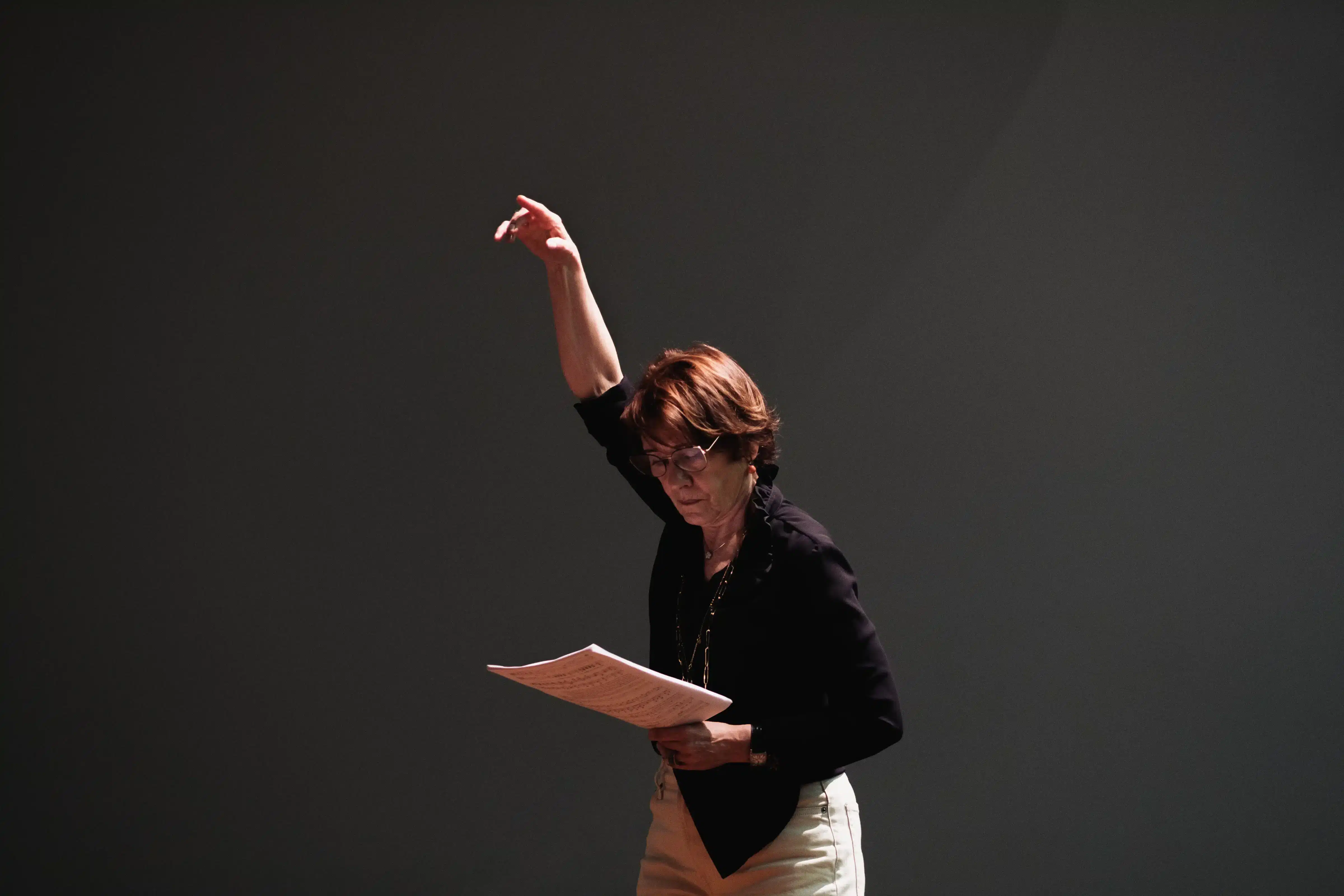
At Cascais Opera, María Bayo didn’t just sit on the jury; she also took part in the masterclasses for the candidates who didn’t progress in the competition. And she’s very enthusiastic about it. “Just coming to the competition and leaving with the result… for them, it’s a bit frustrating. The possibility that someone on the jury, with an artistic background, can then offer them some guidance, show them where they went wrong or where they can improve… I think that’s phenomenal”.
It’s not a common practice, she acknowledges. “I haven’t seen many competitions that do this”. And that is precisely why she values the Cascais Opera initiative. For going beyond the result and treating the competition as a platform for development rather than just selection.
Training never ends
María Bayo is the director of the Centre for Advanced Studies at the Palau de les Arts in Valencia, and she speaks about teaching with the seriousness of someone who takes it seriously. “Training a future artist is a huge responsibility”. She admits that young people today are sometimes sceptical when they receive criticism, “with so many media outlets, they have so much information”, but experience tells her that the initial resistance gives way. “In the second year, there is a change because they realise that it has consequences… and positive consequences”.
The final message she leaves for the Cascais Opera candidates is simple in form, demanding in content: “It’s work, work, continuous work. It’s a complicated, difficult career, but one that brings great satisfaction. You must have a strong calling. And know that it doesn’t happen overnight; it’s a slow evolution, because art itself isn’t immediate”. And he quotes his teacher: “99% is the continuous work you do through daily training”.